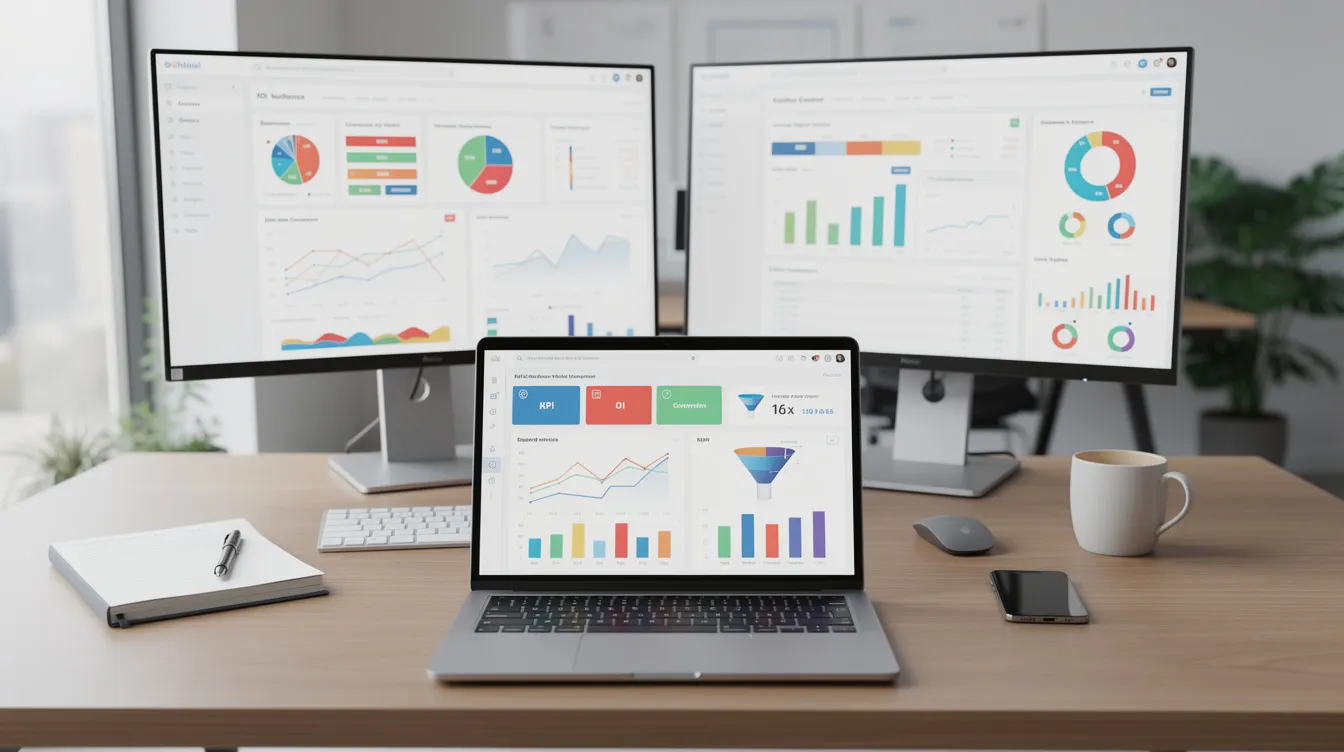

Artificial intelligence is transforming digital marketing into a proactive, data-driven science. But with hundreds of platforms competing for your budget, knowing which ai digital marketing tools actually deliver results is harder than ever. This guide cuts through the noise. You'll get category-by-category tool recommendations, practical workflows, and a clear framework for building a stack that fits your goals in 2026.
AI digital marketing tools are software platforms that use machine learning, natural language processing, and automation to assist with campaign planning, content creation, distribution, personalization, and optimization. They rely on large language models, computer vision, and data analytics engines to do work that used to require entire agencies or large in-house marketing teams.
These ai tools go far beyond copywriting. They power market research, creative testing, audience segmentation, predictive analytics, attribution modeling, and real-time personalization. AI transforms digital marketing by automating repetitive tasks and analyzing vast datasets, giving even small teams capabilities that were enterprise-only just a few years ago. AI automates marketing tasks and enhances decision-making across every channel.
Typical capabilities include:
Between 2020 and 2025, generative ai tools like ChatGPT and Claude made enterprise-level automation accessible to solo founders and small teams. Over 71% of marketers adopted AI tools by 2024, and by 2026, that number has surged to 91%, though only about 6% have fully implemented AI across their workflows. The global market for AI in marketing hit approximately $47 billion in 2025, with projections exceeding $107 billion by 2028.
With that growth comes risk. Data privacy regulations are multiplying: 20 U.S. states now have comprehensive privacy laws, and the EU AI Act is entering enforcement phases for high-risk systems. Bias in automated targeting, opacity of ai models, and misuse of sensitive data are real concerns. Every modern marketing strategy needs clear AI usage policies, data governance, and human oversight built in.
Most top ai marketing tools are built on the same foundations: machine learning algorithms, natural language processing, data analytics, and workflow automation. Understanding these building blocks helps you evaluate tools and avoid paying for features that are just a wrapper on the same underlying technology.
Machine learning algorithms power prediction. They calculate conversion likelihood, churn risk, and optimal bid amounts. Tools like ActiveCampaign use predictive sending and lead scoring to determine when individual users are most likely to open an email or convert. Google Ads AI uses machine learning for automated smart bidding and maximizing conversions. Machine learning models are also at the core of recommendation engines and audience segmentation. AI can automate data analysis, saving marketers time that would otherwise go to manual spreadsheet work.
Natural language processing is what makes chatbots, ai writing tools, and sentiment analysis possible. AI-powered chatbots handle routine queries, freeing up human staff for complex tasks. Social listening platforms like Brandwatch and Talkwalker use NLP to classify the sentiment of brand mentions and cluster emerging topics. Generative content tools use NLP to interpret prompts, adapt to tone guidelines, and produce drafts that match your brand voice.
Data analytics engines unify inputs from web analytics, CRM systems, ad platforms, and email metrics. They enable marketers to see cross-channel attribution, identify keyword gaps, and track traffic trends. AI marketing tools automate data analysis and customer insights, making it possible to act on data points that would take weeks to compile manually.
Workflow automation connects apps and reduces manual work. Zapier and Make link your content tools, CRM, email platform, and project management system so data flows without copy-pasting. AI automates marketing tasks and workflows for efficiency, from tagging new leads to publishing approved blog posts.
You don't need to be a data scientist. But understanding what's machine learning versus a simple heuristic, how much training data a tool needs, and whether sentiment analysis works in multiple languages will help you pick the right ai marketing software for your situation.
Before diving deep, skim this section to identify which categories match your current bottlenecks. Each category below lists two to four tools and a one-sentence summary of what they do best. The goal is to help you prioritize where to start.
Content generation and planning: ChatGPT and Claude lead for long-form content, campaign ideation, and multi-channel brainstorming. Jasper offers structured marketing templates with strong brand-voice controls. Notion AI handles in-context writing, summarization, and project documentation inside content calendars.
SEO and content optimization: Surfer SEO provides real-time optimization scores as you write, with heading and keyword suggestions based on top-ranking pages. Semrush is the broadest all-in-one SEO suite, covering keyword research, rank tracking, and competitor analysis. Clearscope and MarketMuse bring deep semantic and topic coverage scoring for content marketing.
Market research and analytics: Similarweb delivers competitive traffic analysis, referral source breakdowns, and keyword gap reports. Brandwatch powers social listening, sentiment analysis, and trend detection. BuzzSumo and AnswerThePublic surface content topics and frequently asked questions in any niche.
Social media marketing: FeedHive and Lately batch-create posts from long-form content. Hootsuite and Buffer handle scheduling, send-time prediction, and cross-platform analytics. Brandwatch or SocialBee add audience insights and social listening tied to social media campaigns.
Email and lifecycle marketing: ActiveCampaign and Klaviyo excel at predictive segments, dynamic content blocks, and optimizing send times. HubSpot CRM unifies customer data with AI-powered lead scoring and content suggestions. Mailchimp remains a solid entry point for smaller teams.
Video generation and editing: Runway is the current leader in text-to-video quality and cinematic output. Synthesia and HeyGen create talking-head explainers using AI avatars. Descript and Pictory handle transcript-based video editing, auto subtitles, and repurposing blog content into short form videos.
Automation and workflow orchestration: Zapier connects nearly every marketing tool on the market. Make (formerly Integromat) and Gumloop offer AI-native automation for running agents across docs, sheets, and APIs. These productivity tools are what turn isolated ai tools into a connected tech stack.
Keep in mind that 2026 realities like AI Overviews in search, the rise of ai generated videos for digital advertising campaigns, and tighter privacy regulations all shape which tools matter most for your stack.
Generative ai now underpins content generation across blogs, landing pages, ad copy, email sequences, and social posts. AI generates high-quality content for blogs, ads, and social media, and generative AI tools can create high-quality content quickly. The shift in the last two years is that these tools have moved from novelty to daily production infrastructure for marketing teams of all sizes.
ChatGPT and Claude are the two dominant general-purpose writing tools. ChatGPT Plus excels at research, prompt variation, and plugin-driven workflows. Claude Pro consistently ranks higher in writing quality, particularly for long-form content, campaign briefs, and ideation where nuance matters. Both rely on natural language processing to interpret prompts, follow brand guidelines, and generate drafts that align with a given content strategy. For teams exploring Google's ecosystem, Google AI Studio provides access to Gemini models for content experiments and prototyping.
Jasper and Copy.ai are built specifically for marketing teams that need structured templates. Jasper is strong when you need repeatable frameworks for landing pages, Facebook ads, product descriptions, and email sequences. Copy.ai focuses on speed and volume for short-form marketing copy. Both let you define tone, audience, and goals upfront.
Notion AI works differently. Instead of being a standalone generator, it operates inside your existing Notion workspace, helping with in-context writing, summarization, and project documentation. If your content calendar, briefs, and approvals already live in Notion, this keeps everything in one place and reduces context switching. You can even pull in drafts from Google Docs for collaborative editing before publishing.
AI automates routine tasks like brainstorming copy and optimizing ad spend, but best practices still matter:
Content generation is where most marketers first encounter ai tools, but the real value comes when you connect it to optimization, distribution, and measurement.
AI SEO tools now analyze SERPs, competitor content, and user behavior to guide content optimization in minutes rather than days. AI analyzes top-ranking pages and uses NLP to optimize article structure and keywords, which means you can build data-backed briefs before writing a single word. AI can automate keyword research and content optimization, and AI helps predict SEO trends and user behavior so you can stay ahead of algorithm shifts.

Surfer SEO is a leading content optimization platform. It suggests headings, keywords, and structure based on what's actually ranking on Google. Surfer SEO optimizes content based on keyword density and readability, giving you a real-time content score as you draft. It's particularly useful for winning featured snippets and appearing in AI Overviews, both of which reward well-structured, topically comprehensive content.
Semrush is the broadest all-in-one SEO suite available. It combines keyword research, rank tracking, competitor analysis, backlink audits, and AI-powered content templates in a single platform. For teams that need deep insights into competitive positioning and keyword gaps, Semrush is hard to beat.
Clearscope and MarketMuse focus on semantic analysis and topic coverage scoring. They evaluate whether your content addresses a topic comprehensively enough to compete with top-ranking pages, which is increasingly important as search engines reward topical authority.
AI tools can automate content audits and gap analysis, identifying underperforming pages and suggesting improvements. AI can enhance on-page optimization and technical audits, flagging issues like missing meta descriptions, broken internal links, or thin content at scale.
Practical SEO workflows to consider:
When selecting an SEO tool, evaluate:
Content optimization, when done consistently, is one of the most reliable drivers of organic traffic growth and higher-quality leads.
AI has transformed market research from quarterly PowerPoint projects into always-on intelligence that feeds directly into your content and campaign decisions. AI tools can analyze customer behavior from vast data sets, and AI analyzes massive datasets for customer behavior insights, making it possible to spot emerging trends before competitors do.
Similarweb provides competitive traffic analysis, referral source breakdowns, and keyword gap reports. You can see where competitors get their traffic, which channels are growing, and which keywords they rank for that you don't. This kind of competitor analysis used to require expensive consulting engagements.
Brandwatch and Talkwalker are the leading platforms for social listening, sentiment analysis, and trend detection. AI tools can uncover sentiment from customer reviews and social media, classifying mentions by emotion and topic to give you consumer insights that go beyond surface-level metrics. AI tools monitor search trends and platform sentiment to guide content strategy.
BuzzSumo and AnswerThePublic focus on content topic discovery and question mining. They surface the questions your audience is actually asking, which feeds directly into blog topics, FAQ pages, and ad copy angles.
AI can analyze massive datasets to segment audiences effectively. AI enhances customer insights through predictive analytics, using historical data to predict future consumer behavior and market trends. These platforms use machine learning algorithms to detect emerging trends and suggest content angles faster than manual analysis ever could.
Practical applications:
AI enables marketers to work faster and personalize experiences at scale, and market research is where that speed advantage is most visible.
AI supports social media management across ideation, creation, post scheduling, and performance analysis. For marketing teams running social media campaigns on multiple channels, ai powered tools eliminate the most time-consuming parts of the workflow. AI can improve campaign targeting and performance by using engagement data to inform what you post, when, and where.
FeedHive and Lately specialize in AI-assisted post generation. They can take a long-form blog post or webinar transcript and break it into dozens of platform-specific social posts, recycling your best content into fresh angles. This is especially useful for teams producing content marketing at scale.
Hootsuite and Buffer remain the go-to platforms for scheduling, optimal send-time prediction, and basic analytics across LinkedIn, Instagram, TikTok, and X. Both have added built in ai features for caption suggestions and hashtag recommendations.
Brandwatch and SocialBee add audience insights and social listening tied to campaign planning. They help you understand which topics resonate, which formats drive engagement, and where sentiment is shifting, turning social media marketing from guesswork into a data-driven process.
Key workflows:
Do's and don'ts:
Social media marketing drives both brand-building and performance marketing outcomes, and ai powered tools make it possible to do both without doubling your team size.
In 2026, AI video generation and automated video editing have made high-quality video campaigns possible for even small teams. Nearly 90% of advertisers plan to use generative AI to build video ads in the coming year, driven by demand for short form videos on TikTok, YouTube Shorts, Instagram Reels, and connected TV.

Synthesia and HeyGen create talking-head explainer videos using AI avatars, which is ideal for product walkthroughs, training content, and localized marketing in multiple languages. Runway leads in text-to-video quality, offering cinematic output, B-roll generation, and visual effects that previously required a full production team. Descript and VEED.IO handle transcript-based video editing, auto subtitles, and audiogram creation, making it easy to repurpose podcasts and webinars. Pictory converts blog posts into short video clips, pulling key quotes and adding visual elements automatically.
AI generated videos are also increasingly used alongside ai image generators for creating visual assets for digital advertising. Tools with a drag and drop interface, like Canva's video editor, lower the barrier further for non-designers.
Marketers can repurpose existing content into video: AI extracts key moments from a webinar, adds captions, and outputs platform-ready files in minutes.
Key considerations:
Connect video generation to performance data: your top-performing clips should get reused in paid digital advertising campaigns and email campaigns for better ROI.
AI has reshaped email marketing from static newsletters into behavior-based, personalized sequences that respond to individual actions in real time. AI can automate email marketing campaigns for better engagement, and AI tools can automate email marketing campaigns effectively by combining behavioral triggers with predictive timing. AI integrates across CRM, sales, and marketing to generate automated emails and predictive lead scoring.
ActiveCampaign and Klaviyo are the leaders for AI-driven segments, predictive send times, and dynamic content blocks. They analyze purchase history, browsing behavior, and engagement patterns to serve the right message at the right moment. AI tools can personalize customer experiences in real-time, adjusting offers, product recommendations, and content based on live data.
HubSpot CRM unifies customer data with AI-powered lead scoring, content suggestions, and follow-up task automation. For teams where sales and marketing need to share a single view of the customer, HubSpot remains the strongest all-in-one option.
AI-driven tools enhance personalization in marketing strategies by analyzing customer behavior, preferences, and demographics for hyper-personalization. AI-powered recommendation systems suggest products based on user preferences, a model proven at massive scale: over 80% of Netflix's content views come from personalized recommendations. AI enhances customer segmentation by analyzing shared interests and behaviors, enabling marketers to create highly targeted campaigns across multiple channels.
AI predicts consumer behavior, leading to higher ROI on lifecycle campaigns. AI tools enhance personalization in marketing campaigns beyond just using a first name in the subject line. They dynamically swap content blocks, product images, and calls to action based on where each subscriber sits in the customer journey.
Implementation steps:
These tools support your marketing efforts across retention and lifecycle, not just acquisition. The biggest ROI gains in email marketing often come from re-engaging existing customers, not just chasing new ones.
The biggest gains from ai marketing tools often come from connecting them, not just using them in isolation. When your content, email, CRM, and analytics tools talk to each other automatically, you eliminate manual handoffs and reduce errors. AI automates marketing tasks and workflows for efficiency across your entire existing marketing workflows.
Zapier remains the central automation hub for most marketing teams. It links AI content tools, CRM, email platforms, and project management apps with hundreds of pre-built integrations. Gumloop and similar AI-native automation platforms take this further, running AI agents across documents, spreadsheets, and APIs to handle multi-step workflows without constant supervision.
Notion AI combined with Notion's databases serves as an internal knowledge management and campaign tracking system. Teams use it to manage content calendars, store approved prompts, and track campaign assets from brief through publication.
Common automated workflows:
AI optimizes paid ad bidding and crafts tailored content, and connecting these actions through automation means your team spends less time on manual marketing tasks and more time on strategy.
Best practices:
Automation should serve strategy, not replace it. Teams still need clear owners, documented processes, and regular audits of what all the tools in their stack are actually doing.
Tool choice should follow strategy, not the other way around. The biggest mistake marketers make is subscribing to a dozen platforms because they saw a compelling demo, then struggling with integration, overlap, and budget creep. Different ai tools serve different needs, and the best ai tools for your team depend entirely on your goals.
A step-by-step decision framework:
Key evaluation criteria:
Create a short internal RFP checklist and pilot each shortlisted tool for 30 to 60 days with clear success metrics. Measure time saved, content output, and impact on marketing efficiency before committing to annual contracts.
Involve stakeholders from content, performance marketing, and sales so your ai tools support the full revenue engine, not just isolated campaigns. The best ai marketing stack is the one your whole team actually uses.
AI success depends on process, governance, and continuous improvement, not just buying software. AI should be used as a complement to human skill, and the most effective teams build systems around their tools rather than treating them as magic buttons.
Practical guidelines:
Ethical considerations:
Encourage ongoing training for marketers in prompt engineering, data literacy, and experimentation. The pace of change in ai technology through 2026 and beyond means skills need constant updating. Internal workshops, shared prompt libraries, and designated "AI champions" help teams compound their learning rather than starting from scratch with every new tool.
AI can automate data analysis, streamline content production, and power personalization, but marketing strategies still require human creativity, judgment, and accountability.
The next two to three years will bring significant shifts in how ai marketing tools operate and how marketers use them. Several trends visible in 2025 and 2026 are already shaping the trajectory.

Autonomous AI agents that handle multi-step campaigns are gaining traction. These systems can move from ideation to content creation to scheduling to budget allocation with minimal human input, though human supervision remains essential for ethics, brand alignment, and strategic direction.
Search engines are integrating AI Overviews more deeply, which means content must be tailored for both human readers and AI summarizers. Generative engine optimization is becoming a real discipline. AI can automate content audits to ensure your pages are structured for both traditional rankings and AI-generated summaries. This is one of the most important emerging trends in content marketing.
Real-time creative optimization in digital advertising is accelerating. AI optimizes paid ad bidding, swaps creative variants, and adjusts targeting on the fly across channels based on live performance data. AI uses historical data to predict future consumer behavior and market trends, making campaigns more responsive and ad spend more efficient.
Regulatory shifts will continue. The EU AI Act's enforcement for high-risk systems is underway, and more U.S. states are expanding definitions of sensitive data. Organizations that build compliance into their ai tools selection process now will avoid costly retrofits later.
First-party data is becoming the foundation of effective personalization. As third-party cookies phase out, tools that help collect, manage, and activate consented first-party data, like CDPs and privacy-centric analytics platforms, will become central to every marketing strategy. AI enhances customer segmentation, but only when the underlying data is collected ethically and managed responsibly.
Marketers who treat AI as a long-term capability, investing in skills, processes, and governance, will consistently outperform those chasing one-off hacks. The competitive advantage isn't in which tool you buy. It's in how deeply you integrate AI into your thinking, your workflows, and your team culture.
A lean starting stack can be as simple as one generative AI writing tool (ChatGPT or Claude), one SEO and content optimization tool (surfer seo or Semrush), and one automation layer (Zapier) connected to your email platform. This combination, costing roughly $60 to $200 per month, has been shown to save small teams around five hours per week. Focus on one or two high-impact workflows, such as blog production plus email nurture, for the first 90 days before expanding. Add video generation or advanced analytics once the basics are stable and showing ROI.
Search engines in 2026 care more about usefulness, originality, and expertise than whether a human or AI typed the first draft. Always add human editing for accuracy, unique perspectives, and brand voice, and back claims with sources and real data. Run drafts through content optimization tools like Surfer SEO and plagiarism checkers, and avoid mass-publishing thin, generic articles. AI can automate keyword research and content optimization, but quality control is still a human responsibility.
Safety depends on the vendor. Check each tool's privacy policy, data residency, and whether prompts or inputs are used to train public models. Use enterprise or "no training" modes where available, and never send full PII in prompts. Work with your legal and security teams to approve tools and define what data can be processed by external AI services. With GDPR enforcement actions totaling approximately €5.65 billion and U.S. states rapidly expanding privacy laws, this is not optional.
Start with internal workshops on prompt engineering and data literacy, then assign small AI experiments tied to real campaigns. Document successful prompts and workflows in a shared knowledge base (Notion or similar) so skills compound over time. Pair less-experienced team members with "AI champions" who test new ai features and tools and share best practices monthly. In 2024, AI adoption in marketing reached 71%, which means most teams are already experimenting. The gap is between experimenting and systematically improving.
AI is more likely to change these roles than eliminate them. Professionals who learn to direct and quality-check AI outputs will be in higher demand. AI still struggles with deep brand insight, complex strategy, and emotionally resonant storytelling, all of which require humans. Copywriters, designers, and media buyers should lean into higher-value activities like strategy, concept development, and experimentation while letting AI handle repetitive execution. The marketers who combine human creativity with ai algorithms and actionable insights from data will define the next era of digital marketing.