
The way people find information online is undergoing its biggest shift since Google replaced phone books and library catalogs. AI powered search now sits between users and the websites they used to click, generating conversational answers instead of handing over a list of links. If you create content, sell products or depend on organic traffic, this transformation demands your attention.
AI powered search describes search experiences where artificial intelligence systems, especially large language models, interpret queries, retrieve relevant sources and synthesize natural language answers. AI-powered search employs natural language processing and large language models to understand what a user actually means, not just what they typed.
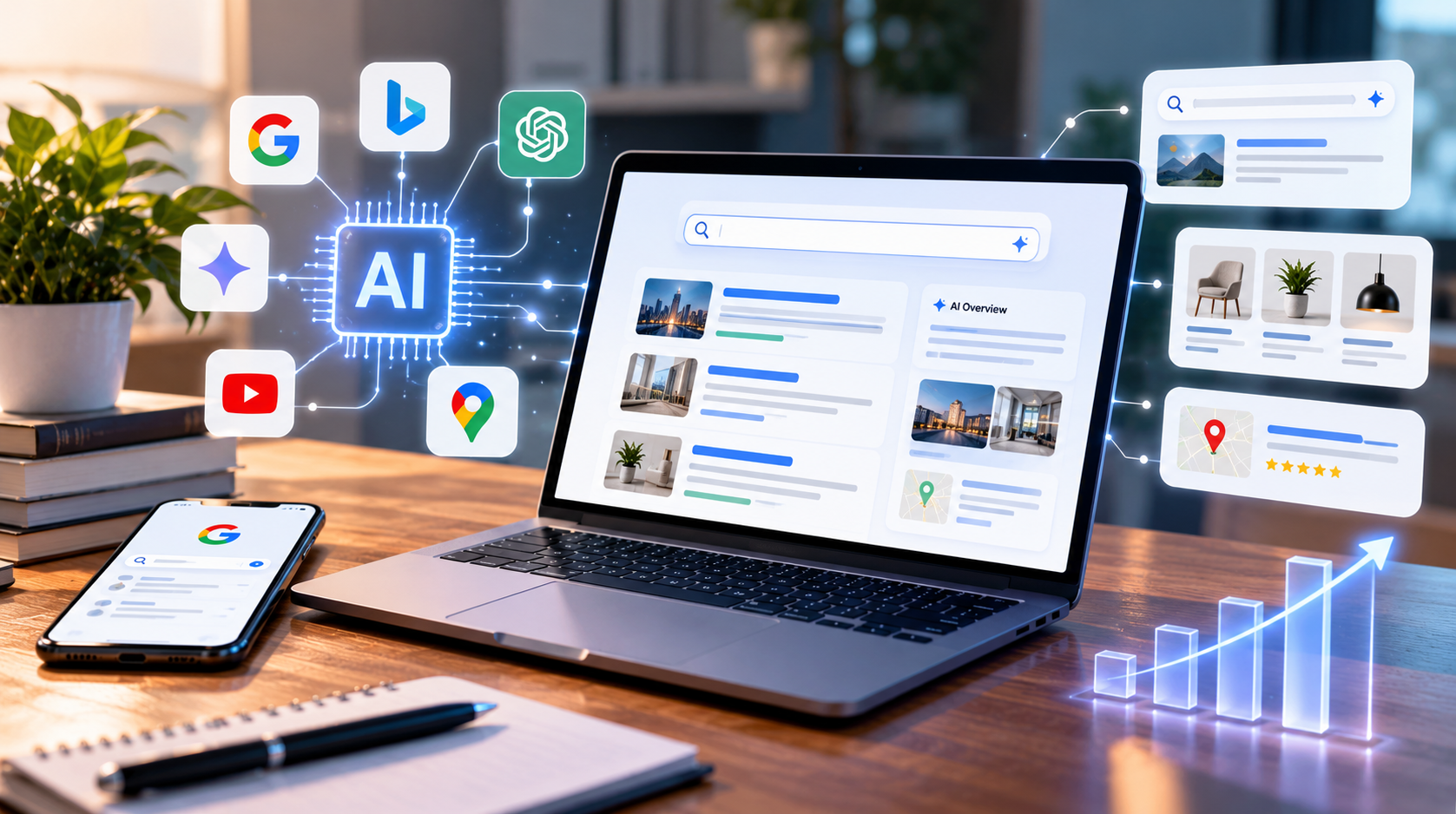
This differs sharply from classic ten-blue-link search engine results pages. Instead of scanning a ranked list of individual web pages, users see a synthesized answer box, inline citations, follow-up prompts and sometimes no need to click at all. AI-powered search combines traditional results with AI-generated answers, creating a hybrid search experience. It can handle typos and informal language effectively, and it supports multi-turn conversations without starting over each time, allowing for conversational follow-ups rather than rigid queries.
Real-world examples from 2025 and 2026 include Google's AI Overviews and AI Mode, Bing's AI chat and Copilot, ChatGPT Search, Perplexity and You.com. Each blends generative answers with web links in slightly different ways. AI Overviews triggered in roughly 6.5% of desktop queries in January 2025 and jumped to about 13.1% by March 2025, a 72% increase over just two months.
The typical AI search pipeline works like this: first, the query is understood, parsed for intent, entities and context. Next, the system retrieves relevant passages from an index or vector database. Then it ranks and re-ranks those passages, enriches them with entity data and freshness signals, and finally synthesizes a fluent response with citations. AI-powered search can summarize lengthy materials into cohesive answers and can analyze and synthesize information from multiple sources in a single response.
AI search now covers both general search engines and vertical domains. Ecommerce search, documentation search, in-app search and enterprise knowledge management are all increasingly powered by AI. It understands complex inquiries better than traditional search and discovers relevant information more quickly, reducing the time users spend searching.
This section is a high-level technical overview for marketers and product teams. You do not need a data science background to follow along, though data scientists familiar with these systems will recognize the core components.
Large language models sit at the center. They interpret natural language queries, perform internal query rewriting (expanding "best shoes" into detailed intents covering style, price and use case) and generate fluent answers. AI-powered search uses artificial intelligence for understanding user intent, which means it interprets the meaning and context of user queries rather than relying on exact keyword matching.
Semantic search using vector embeddings is the retrieval backbone. User queries and documents are mapped into a numerical space where conceptually similar content clusters together. This makes semantic search knowledge critical: a query about "affordable electric crossover" matches content about "budget EV SUVs" even without shared words. Hidden semantic relationships between terms and concepts surface through this approach, going well beyond traditional keyword matching.
Knowledge graph learning connects entities like people, places, brands and products through structured relationships. Semantic knowledge graphs help AI distinguish "Apple the brand" from "apple the fruit" and link your brand to categories, certifications and locations.
Retrieval augmented generation makes this practical. When a user asks a question, the system retrieves top passages from an index and uses them as evidence while generating the answer. AI-powered search delivers highly targeted results using LLMs grounded in retrieved content, reducing hallucinations and enabling citations. Roughly 37.9% of pages cited in Google AI Overviews also rank in the top 10 for that query, but many citations come from pages outside those positions.
Crucially, ranking and selection now operate at paragraph or passage level, not just URL level. The first 30% of a page's content generates about 44.2% of all citations, meaning where you place your strongest claims matters enormously.
Picture a 2026 user asking: "Compare electric SUVs under $50k with 5-star safety ratings and best warranty." Instead of typing three separate search queries and scanning dozens of individual web pages, they get a single conversational response covering price, safety, warranty and availability. AI-powered search helps consumers compare various products efficiently and enhances decision-making with comparative analyses in one interaction.
Natural language queries are longer, more specific and more conversational than classic keyword strings. Users ask full questions or chains of follow-ups, reducing the importance of exact-match phrases. AI-powered search synthesizes information into direct, conversational responses, and it synthesizes information rapidly, reducing time spent searching.
Zero-click behavior is accelerating. Research found that when AI Overviews appear, click rates drop from roughly 15% to 8%. About 26% of search sessions ended immediately after seeing an AI Overview, compared to 16% without one. This shifts search engine optimization goals from "get the click" to "own the answer and citation."
AI search blends informational, commercial and local intent in one thread. A single dialogue might answer what, why, which brand, and where to buy. AI-powered search can provide hyper-personalized results based on preferences and context, refining recommendations as the conversation progresses. Personalized search is amplified because AI systems recall previous questions and preferences session by session.
Think about a Google search results page circa 2018: ten blue links, a few ads, maybe a featured snippet and a knowledge panel. The number-one result captured strong click-through rates, and individual web pages in positions two through five still earned meaningful traffic.
Now compare that to a 2026 Google search with AI Overviews and AI Mode toggles. A synthesized AI answer sits at the top, often answering the query outright. Fewer visible organic links appear above the fold, surrounded by more search engine results pages features: videos, images, People Also Ask, shopping units and AI follow-ups. Traditional search relies primarily on keyword matching and indexing, while AI powered search layers intelligence on top of that same foundation. Over 3 trillion searches are processed annually on Google, and the AI layer is reshaping how those queries resolve.
Google Search still uses crawling, indexing and ranking under the hood. The same index feeds both classic search results and the AI layers that create summaries, recommendations and comparisons on the fly. Search engine technology has evolved, but the infrastructure hasn't been replaced. It has been augmented. AI-powered search provides personalized results based on user context, making the experience feel tailored rather than generic.
Click-through rate shifts have been dramatic. One study across 42 organizations found a roughly 61% drop in CTR on queries where AI Overviews appeared. Rank-one positions saw up to a 58% reduction in CTR. A randomized experiment with 1,100 users showed external click-through fell by 18.8 percentage points when AI Mode was forced. These numbers are directional, not universal, but the trend is clear.
AI powered does not mean fully opaque. Links, structured data, page experience and authority still matter to both classic and AI layers of search. Search engine algorithms still reward quality, relevance and trust.
Here is the reassurance many search practitioners need: core SEO fundamentals still underpin success in AI environments. The priorities are evolving, not disappearing.
Evergreen pillars remain essential:
AI is transforming SEO strategies significantly by 2025 and beyond. Keyword research evolves but does not disappear. The focus shifts from exact-match phrases to topic clusters, entities and question patterns users will ask AI. AI SEO services that still only chase single keywords are falling behind.
Group keywords by user jobs-to-be-done, tasks and problems, rather than just shared words. This maps better to conversational journeys. For example, "electric SUV" queries might cluster around safety, warranty, subsidies, charging cost and maintenance.
A technically sound, crawlable, fast site remains non-negotiable. Building intelligent search systems, whether Google's or your own on-site search, largely depends on search indexes and crawlers such as Googlebot and Bingbot. If your technical SEO is broken, you will not enter the retrieval set at all.
"AI SEO" and generative engine optimization mean structuring content so AI systems can easily quote, summarize and trust it. AI SEO tools enhance content relevance for search engines while AI-powered tools automate keyword research and content optimization.
Writers should answer primary and secondary intents in the same piece: definitions, how-to steps, pros and cons, costs, alternatives, risks and next steps, arranged with clear headings. AI technologies enhance search relevance and user experience significantly when content is organized this way.
Use question-style H2 and H3 headings that echo how people ask AI tools. For example, "How does AI-powered search affect keyword research?" mirrors a real conversational query and boosts passage-level selection. Think of each heading as a potential search query in AI mode.
Dense, self-contained paragraphs are critical. Each paragraph should be liftable as a citation in AI Overviews or ChatGPT answers, including brand names and concrete claims. Put core statements early in sections, since data shows early content disproportionately drives citations.
Include first-party data, case studies, dates and unique perspectives. AI optimized content differentiates itself from generic AI-generated text through original insights and interesting and relevant examples that no model can fabricate.
Implement schema markup: FAQ, HowTo, Product, LocalBusiness. Structured data helps both traditional Google search and AI layers understand entities, relationships and page type. This is where summarization combining search intelligence with structured data markup produces the best outcomes.

Keyword research in 2026 is less about single phrases and more about questions, entities and thematic coverage. AI-driven SEO tools enhance keyword research and content creation by surfacing patterns humans would miss across millions of queries. AI-powered tools automate keyword research and performance tracking, freeing up time for strategy.
AI powered tools combine machine learned ranking models and natural language processing to cluster search queries, discover long-tail topics and infer intent patterns across platforms. AI tools improve SEO strategies by analyzing vast data sets that would take humans weeks to process. AI can predict future search trends within minutes, and AI-driven SEO tools can predict future search trends within minutes, giving teams a head start on emerging topics.
Practical workflow: start with classic tools like Google Search Console and search trends data, then feed topics into AI tools or large language models to expand question lists and related entities. This lets you integrate large language models into your research process without abandoning proven methods.
Focus on relevant keywords that still drive clicks, particularly transactional and high-intent queries, while also mapping zero-click informational queries that build search visibility through AI citations. Track search intent carefully: are users looking to learn, compare or buy?
Opportunities live in underserved topics: nuanced comparisons, local-specific questions, regulations, pricing breakdowns and edge scenarios. These are where an existing search engine often lacks depth and where AI actively seeks authoritative sources to cite.
AI personalization is a major shift. Intelligent search systems tailor results based on history, location, device, language and inferred preferences. AI algorithms improve personalization of search results significantly, and AI personalization improves search results relevance and user experience in ways that feel intuitive to users.
LLMs personalized search behavior by analyzing context within and across sessions. AI tools analyze user intent for personalized search results, while AI-driven tools analyze user interactions to improve search results over time. AI search tools analyze qualitative feedback and behavioral trends, and AI tools help businesses refine audience targeting and customer segmentation based on what those signals reveal.
Strengthen entity clarity for your brand: consistent name-address-phone data, thorough About pages, author bios, product specs and organization schema with sameAs links to official profiles. Knowledge graph learning lets systems connect your brand with categories, locations, products, founders and certifications as structured entities.
Trust and safety signals matter heavily. Transparent sourcing, real author expertise, up-to-date information and low spam risk all influence whether AI systems cite your content. In 2026, AI systems increasingly downrank scaled, low-quality AI content and favor sites with clear human oversight and verifiable credentials. A former chief algorithms officer at a major search engine once noted that signals boosting models learning are fundamentally about trust, not tricks.
Answer engine optimization is optimizing to be the direct answer in SERP features like featured snippets, People Also Ask and instant answers. Generative engine optimization targets inclusion in generative AI responses across platforms. SEO will evolve to include generative engine optimization as a core discipline alongside traditional search engine rankings tactics.
AEO traditionally focused on Google snippets; GEO now targets AI-powered search experiences like Google AI Overviews, Bing Copilot and ChatGPT Search. Anyone interested in the broader theory should consider reading a book AI powered search practitioners recommend for building world class search experiences and delivering effective search at scale.
AEO tactics:
GEO tactics:
Measurement is challenging. AI answer inclusion is harder to track than search engine rankings. Brands must combine manual spot checks across AI Overviews, ChatGPT and Perplexity with specialized AI visibility tools and traffic trend analysis. AI-driven SEO tools can predict future search trends within minutes, but tracking citation presence requires new workflows. Automate ongoing relevance improvements by monitoring which queries trigger AI answers and whether your domain appears.
Search behavior is diversified. Users turn to Reddit, TikTok, YouTube, Instagram, Amazon and AI assistants alongside Google search. The search game has expanded far beyond a single engine. Multimodal search, including voice search and image-based queries, adds further complexity.
AI-powered search has the potential to improve customer experiences significantly across all these surfaces. It helps consumers compare various products efficiently and enhances decision-making with comparative analyses, whether the user is shopping, researching or planning. AI-powered search reduces information retrieval costs for businesses and is increasingly used in enterprise knowledge management for internal discovery.
Local SEO is changing fast. AI answers often combine local packs, reviews, hours, pricing ranges and "best for" recommendations into one response. Strengthen local signals with fully optimized Google Business Profiles, LocalBusiness schema, FAQs about services and hours, consistent citations and genuine reviews.
Social content now surfaces in Google search and feeds AI training data. Aligning blog and social topics reinforces the same topical authority. Repurpose authoritative content across video, social posts and long-form pages to increase chances of discovery and citation by highly intelligent search applications. This is digital marketing innovation in action: meeting your target audience wherever they search.
This is a concise, chronological roadmap for teams starting now and iterating over three to four years. Technology modern search demands ongoing adaptation, not one-time fixes.
Phase 1: Audit (Month 1–2) Assess crawlability, indexation, structured data coverage, content depth, entity clarity and current visibility in AI answers. Use search console data to identify which queries already trigger AI Overviews. Implement AI search monitoring for your highest-value queries.
Phase 2: Content Upgrade (Month 3–6) Prioritize pages ranking in positions 5 through 20 and those occasionally cited by AI systems. Enhance depth, structure and originality. Ensure every key page has self-contained paragraphs that can be quoted, clear entity references and schema markup. Ongoing relevance improvements should be baked into your editorial calendar.
Phase 3: Conversational Content Experiments (Month 6–12) Create topic clusters mirroring user question chains. Test internal linking patterns that support AI understanding. Experiment with question-style headings and FAQ blocks. SEO optimization at this stage becomes about anticipating the follow-up, not just the first query.
Phase 4: Track and Iterate (Ongoing) Monitor organic traffic, branded versus non-branded demand, AI Overview impacts, conversational query impressions and on-site engagement. Digital marketing teams should follow official Google Search documentation, AI policy updates and trusted SEO research sources. The search algorithms powering AI answers will keep evolving, and your seo strategies must evolve with them.
AI-powered search is a double-edged sword. It delivers better answers faster, but it also introduces risks of hallucinations, bias and over-reliance on opaque systems. AI-powered search may generate incorrect or misleading information occasionally, and brands need to take this seriously.
Concrete risks for brands include AI misquoting content, outdated summaries, unbalanced competitor comparisons and exposure of partial or incorrect information at scale. When machine learning algorithms select which passage represents your brand, the stakes are high.
Transparent disclosures matter when using AI-generated or AI-assisted content. This builds user trust and aligns with evolving search engine guidelines. Search engine results quality depends on honest, well-sourced content.
Invest in human review of critical content. Maintain clear editorial standards and avoid shortcuts like mass auto-generated articles for SEO gain. The search practitioner who relies entirely on automation without human oversight risks both penalties and reputational damage.
Regulatory and privacy considerations are emerging rapidly in 2025 and 2026, from data protection rules to copyright questions around training data. Monitor legal developments affecting AI search. The landscape will keep shifting, and responsible brands will stay informed.
There is no single universal dashboard yet. Marketers can run test queries in Google AI Overviews, Bing's AI chat, Perplexity and ChatGPT to check for citations of their domain. Maintain a list of high-priority search queries and periodically sample them manually or with specialized AI visibility tools that capture and log citations over time. Correlate observed citations with analytics data such as organic traffic, direct visits and branded search volume to infer business impact even when clicks are reduced.
Keyword research remains essential, but the focus shifts from chasing exact-match phrases to understanding topics, entities and question patterns. Continue using tools like search console and keyword platforms to see how people phrase problems, then expand with AI tools into conversational questions. High-intent and transactional keywords still drive revenue and deserve dedicated landing pages optimized for both classic SERPs and AI answers.
While large brands have advantages in authority and data, AI systems also value specificity, expertise and niche depth where smaller players can excel. Small businesses should own narrow topics, locations or verticals with experience-rich content, clear local signals and transparent pricing. In many local and B2B niches, high-quality, focused content still wins AI citations even when competing against larger, more generalist sites.
Review key pages at least every 6 to 12 months, with more frequent updates for fast-changing topics like regulations, pricing or technology releases. Meaningful updates, including new sections, data and interesting and relevant examples, matter more than simply changing dates. Track pages with declining performance in search console and prioritize them for refresh targeted to current user questions and AI search behavior.
AI can safely assist with ideation, outlines and first drafts if all outputs are reviewed, fact-checked and rewritten where necessary by humans. Publishing unedited AI text at scale can lead to accuracy issues, thin content and potential penalties under evolving search quality systems. Use AI primarily to accelerate research and drafting while relying on human subject-matter experts to provide original insights, examples and final polish.