
If you're running Google Ads, one of the biggest decisions you'll face is choosing between Search Campaign vs Performance Max. Both campaign types are designed to generate leads and sales, but they operate in completely different ways.
Many businesses wonder whether search campaigns are still the best choice now that Google Performance Max has become one of Google's flagship campaign types. While performance max campaigns use Google's automation and AI to reach customers across multiple platforms, traditional Search campaigns continue to deliver outstanding results for businesses that rely on high-intent traffic.
The right choice depends on your business goals, budget, industry, and how much control you want over your advertising. In this guide, we'll compare Search Campaign vs Performance Max, explain their key differences, and help you determine which campaign type is best for your business.
Google Ads Search Campaigns display search ads directly within Google Search whenever someone types a relevant query.
Unlike automated campaigns, keyword based search campaigns only target users who are actively searching for your products or services.
For example, if someone searches "digital marketing agency Auckland," your Google Search Ads can appear above the organic listings.
This makes Search one of the highest-intent advertising channels available.
Traditional search campaigns rely on specific keywords, bidding strategies, and compelling ad copy.
When a user's search query matches your selected keywords, Google decides whether your ad should appear in the search results.
You maintain complete control over:
This level of control makes Search campaigns ideal for advertisers who want predictable campaign management.
Google Performance Max is an AI-powered campaign type introduced in November 2021.
Instead of focusing only on search traffic, performance max campaigns distribute ads across multiple Google properties, including:
Rather than targeting keywords directly, performance max campaigns work using automation, machine learning, conversion data, and audience signals.
When launching Performance Max, advertisers provide:
Google AI then automatically builds ad combinations using these creative assets.
It even creates automatically created assets if enabled.
The system continuously tests different combinations across multiple Google channels.
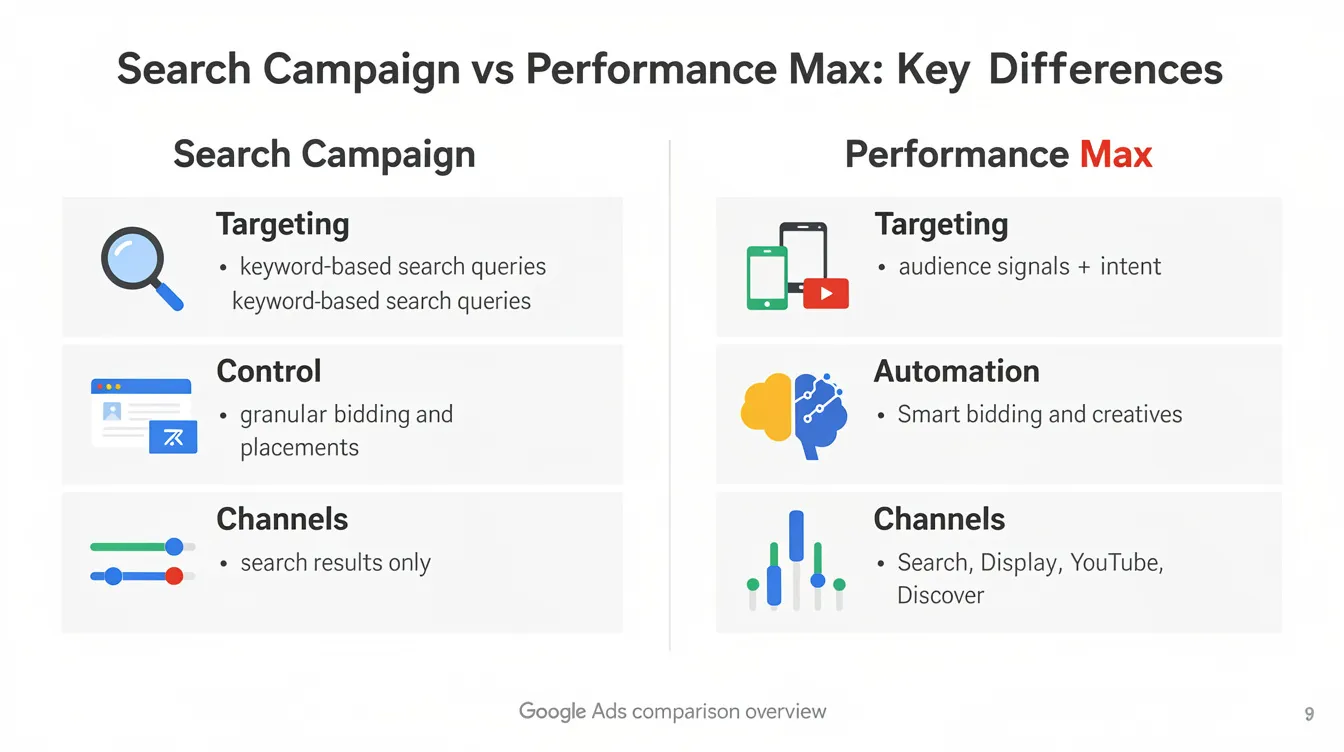
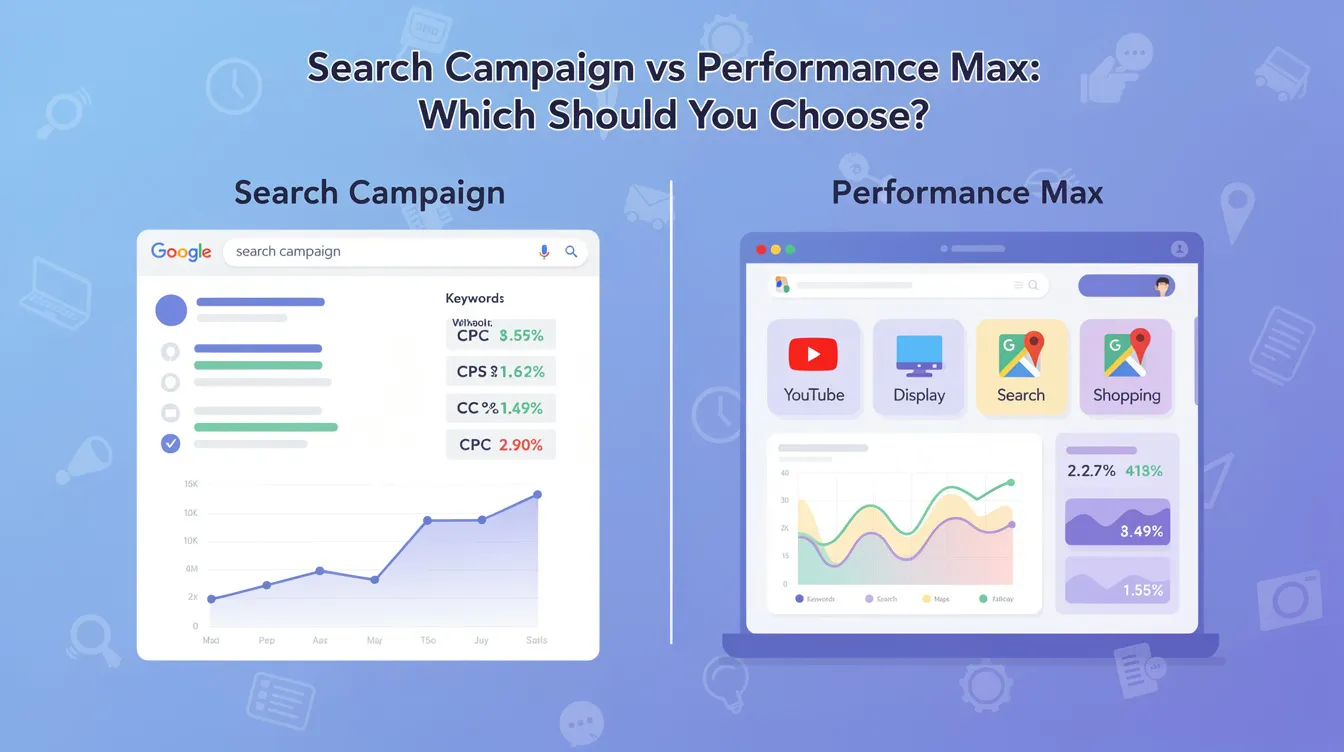
The biggest distinction in Search Campaign vs Performance Max is where ads appear.
Search campaigns display only in Google Search.
Performance Max distributes ads across multiple Google Networks.
That broader reach can generate more impressions but also introduces less predictable traffic quality.
Traditional search campaigns rely on specific keywords.
Performance Max uses automated targeting powered by Google AI.
Instead of selecting keywords manually, advertisers provide audience signals, allowing Google's automation to find potential customers.
One of the biggest differences between Performance Max vs Search is how much control advertisers retain.
Search campaigns provide:
Performance Max offers much less manual control.
Most optimization decisions are handled by Google's automation.
With Search campaigns, advertisers perform keyword research to identify high intent keywords.
They can use:
Advertisers also manage match types, monitor search terms, and add negative keywords to eliminate irrelevant traffic.
This provides exceptional targeting precision.
Unlike Search campaigns, PMax campaigns do not rely on advertiser-selected keywords.
Instead, Google's AI analyzes:
This reduces manual management but also decreases transparency.
Search campaigns provide extensive reporting.
Advertisers can analyze:
This data helps optimize campaign performance continuously.
One common criticism when comparing Performance Max is limited reporting.
Performance Max offers less visibility into:
This lack of transparency can make optimization more difficult.
Search campaigns allow advertisers to add negative keywords directly.
This prevents ads from showing for irrelevant searches.
It helps improve conversion rates while reducing wasted ad spend.
Historically, Performance Max has offered limited negative keyword functionality.
Advertisers have far less control over excluding unwanted traffic compared with traditional search campaigns.
Industry data suggests search campaigns average around a 3.5% conversion rate.
This is because they target users already looking for specific products or services.
Search campaigns excel at lead generation because they capture lower-funnel buyers.
Industry benchmarks suggest performance max campaigns average approximately a 1.5% conversion rate.
However, they typically generate significantly higher impression share because they reach audiences across multiple Google Networks.
For service businesses, Search campaigns often outperform automated campaigns.
Potential customers already know what they need and actively search using specific keywords.
Examples include:
These industries benefit greatly from keyword based search campaigns.
E commerce businesses often benefit from performance max campaigns.
Performance Max integrates directly with a Merchant Center Account.
It automatically promotes products through:
This creates highly scalable shopping experiences.
Search campaigns mainly require:
Because they rely primarily on text based ads, creative requirements remain relatively simple.
Performance Max requires significantly more content.
You'll typically need:
Strong creative assets are essential for maximum performance.
Search campaigns support multiple Smart Bidding strategies while still allowing manual adjustments.
Advertisers retain flexibility to optimize bidding according to campaign goals.
Performance Max relies heavily on Smart Bidding combined with machine learning.
Google AI automatically adjusts bids to maximize conversions based on historical data.
Search campaigns send users to carefully selected landing pages that directly match their keywords.
Highly relevant landing page content improves Quality Score and conversion rates.
Performance Max includes Final URL Expansion, allowing Google to automatically choose landing pages.
Although convenient, advertisers have less control over which pages users visit.
Businesses with smaller budgets often achieve better ROI using existing search campaigns.
Since traffic comes from users actively looking for services, every click tends to have higher intent.
Businesses with larger advertising budgets often run Performance Max alongside Search campaigns.
Performance Max expands reach beyond active searchers.
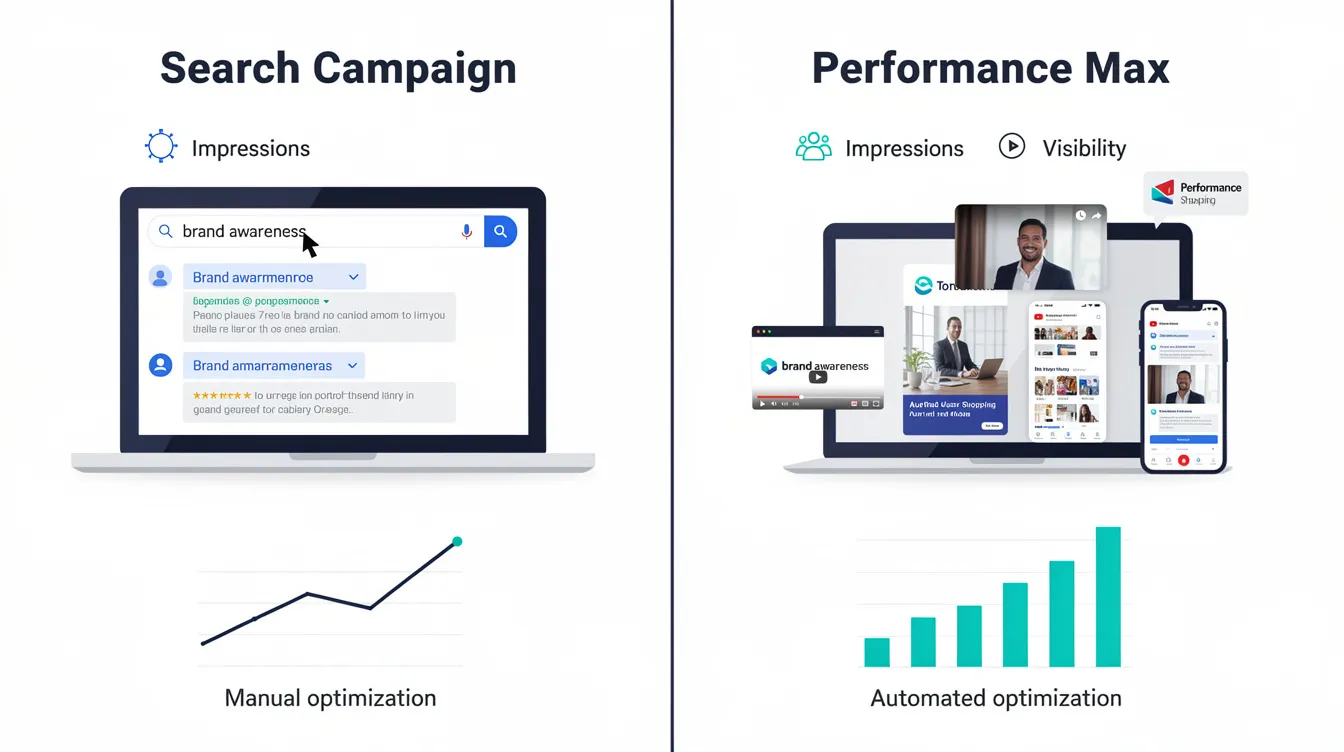
Performance Max generally performs better for brand awareness because it reaches audiences across multiple Google Channels.
Search campaigns mainly focus on conversion-ready users rather than awareness.
For local service based businesses, Search campaigns usually provide better returns.
Customers searching "near me" already have purchase intent.
Performance Max can supplement Search but rarely replaces it completely.
Rather than choosing one, many advertisers combine SEO and Paid Ads—and similarly, the best Google Ads strategy often uses both Search and Performance Max together.
Running separate campaigns allows Search to capture high-intent traffic while Performance Max expands reach across additional Google Properties.
Studies indicate that combining both campaign types can improve overall performance by approximately 23–38%.
If using both:
Search campaigns offer:
Performance Max provides:
Choose Search if you:
Performance Max works best when you:
When evaluating Search Campaign vs Performance Max, there isn't a single winner for every business.
If your priority is high-intent traffic, predictable performance, and detailed reporting, Google Ads Search Campaigns remain the strongest choice. They provide precise keyword targeting, greater transparency, and more control over bidding, ad copy, and optimization.
If your goal is broader reach, automation, and scaling across multiple Google Networks, Performance Max campaigns are an excellent complement. They leverage Google AI, audience signals, and automated bidding to expand beyond traditional search.
For most businesses, especially those focused on long-term growth, the most effective approach isn't Performance Max vs Search, it's using both strategically. Let Search campaigns capture users who are actively searching with high intent, while Performance Max uncovers additional opportunities across Google's ecosystem.
By aligning each campaign type with your conversion goals, audience, and budget, you'll maximize performance, improve ROI, and build a more resilient Google Ads strategy.